
PRIMARY:
- Jonathan Franzen, The Corrections (2001)
- Jennifer Egan, A Visit from the Goon Squad (2010)
SECONDARY:
- Peter Boxall, Twenty-First-Century Fiction: A Critical Introduction (2013) *
- Stephen Burn, Jonathan Franzen at the End of Postmodernism (2011)
- Nicholas Dames, “The Theory Generation”, n+1 (2012) [here]*
- Jonathan Franzen, “I’ll Be Doing More of Same”, Review of Contemporary Fiction, 16:1 (1996), pp. 34-38 *
- Andrew Hoberek, “Introduction: After Postmodernism”, Twentieth Century Literature, 53:3 (Fall, 2007), pp. 233-247 (233)
- Amy Hungerford, “On the Period Formerly Known as Contemporary”, American Literary History, 20:1-2 (Spring/ Summer 2008), pp. 410-419
- Adam Kelly, “Beginning with Postmodernism”, Twentieth-Century Literature, 75:3-4 (Fall/ Winter 2011), pp. 391-422 *
- Robert McLaughlin, “Post-Postmodern Discontent: Contemporary Fiction and the Social World”, symplokē, 12:1/2 (2004), pp. 53-68 *
Pre-Class Notes
— Your pre- and post-class notes should look a little something like this (so begin with a double dash). They are meant to be a conversational yet critically-engaged record of your thoughts on the reading, and a space in which you can share suggestions and other reading/viewing/ listening material. So if, for example, you’re interested in the music history Egan sketches in Goon Squad, you might think it’s helpful to direct people to a spotify playlist of songs from the book, or other musical responses to the novel, like this one from the New Yorker . At the end of your first comment, put your full name followed by your initials in square brackets; for subsequent comments, just your initials will do. [Mike Kalisch, MK]
—
Jonathan Franzen, The Corrections
In “I’ll Be Doing More of Same,” Franzen discusses the decline of the novel which the “general” audience of “Americans who considered themselves civilized” would read. Indeed, Franzen’s writing style in The Corrections appears to lean toward detailed, longer, and realist passages reminiscent of the very writers he declares is “being rendered obsolete,” such as Dickens, Proust, or Pynchon; or as Nicholas Dames writes in “The Theory Generation,” “[describing] individual lives in a fairly linear manner.” The scrupulous omniscient narration and heavily descriptive passages, to me, felt slightly dense and almost anachronistic, but perhaps only because I have been steeped in modern “tribalist” literature which more often takes on the concise Hemingway approach to syntax and overall structure than that of the increasingly outdated style of Fitzgerald.
At this point I have to admit I had little patience with the packed, linear narrative Franzen employs—which, admittedly, he suggests is due to a decline in the intellectualism of the literary audience—and had little sympathy for the characters in The Corrections; the messed up dynamics of a family with its undercurrent of dishonesty, frustration, and disappointments might have been what Franzen understood to be the average American experience, but whether you call it human or realist, their sense of entitlement seemed to verge on a luxury many Americans today would have no access to. Chip, for instance, is a sexual offender who faces no legal prosecution or long-term consequence, rebuilding his life with the help of Gitanas; Denise, wrapped up in the safety of middle-class exemption from moral imperatives; Alfred and Enid, fretful over anxieties that stem from their own expectations.
Franzen further expresses dismay towards the contemporary literary trend which he calls “tribalism” and “identity politics,” describing them as totalitarian, albeit recognizing the writers to be doing us all “a favor.” I find it ironic that he claims to recognize Toni Morrison as the “beginning and end” of the list of “American novelists who might be heeded as a cultural authority,” and yet fails to recognize that Morrison, along with the likes of Alice Walker, Langston Hughes, or Zora Neale Hurston, are figures recognized as spearheading the so-called tribalism writing from the angle of marginalized identities that previously didn’t have access to mainstream platform; it is not that a general audience with an appreciation for literature has disintegrated, but that readers increasingly have a wider, and hopefully more diverse array of writers who offer the perspective of American life in ways that each reader is able to sympathize with. It might not be “identity politics” if mainstream writers and critics didn’t feel the need to categorize marginalized writers as token poc or lgbtq names to sprinkle on top of their sense of social awareness, failing to recognize they capture the essence of Americana. Perhaps Franzen recognizes a cultural identity that penetrates the American experience in those that reflect his own; after all, the mainstream literary intellectual has always been, and still remains, representative of white, middle class, male, heterosexual privilege.
Jennifer Egan, The Visit from the Goon Squad
I enjoyed the clarity and candor of her prose and the distinctive voice she maintained for each character. The number of perspectives she includes could have easily become confusing to follow, especially as she jumps back and forth in chronology, but I found the novel didn’t fall apart, the connections between each chapter and character well developed, and her writing paced as such that the reader didn’t lose sight of the whole novel, or the network of relationships she delineates. I also appreciated how she tied the novel at the end by returning to the characters she’d started out with, this time focusing on Alex, who had initially been a more marginal character. The novel dismantles the idea of a single deserving protagonist, thus championing individualism .
The series of chronological diagrams which Egan employs toward the end of her novel suggests her own experimentalism, though not entirely in line with the mode she formerly writes in. I unfortunately found it less coherent and more difficult to follow than her narrative form, but also thought it disproved Franzen’s claim that “formal innovation is coming to an end.” On Nicholas Dames’ argument that Egan’s Mindy captures the theory generation, I read Mindy’s character as demonstrating irony by classifying simple reasoning into academic texts that begin with “structural,” an academic platitude. I found Mindy’s ironic thought pattern to be another example of dry humor, a kind of cleverness Egan displays when she provides brief future insight into her characters’ lives, as if to highlight the characters’ ignorance and the futility of the moment in which the narrative takes place; (ex. “Charlie doesn’t know herself. Four years from now, at eighteen, she’ll join a cult across the Mexican border. (80)) The cleverness of the irony renders the narrator as interesting as the characters themselves.
On another note, I enjoyed her use of the second person perspective at certain points throughout the book, as in the case of Rob’s section. Writing in the second-person is a growing, if tricky, trend, again frowned upon by a sizable portion of established writers, and one that I also believe has to be justified; for the most part I believed she wrote successfully in this point of view, though I didn’t see enough explanation for the need to employ the particular perspective. [Jane Kim, JK]
—
I am struggling to articulate my thoughts on this week’s novels without a personal inflection. Dames’ observation in his n+1 article, ‘The Theory Generation’ that Theory has been subsumed into ‘the sociology of late adolescence’, that Mindy’s attempt to abstract her safari experience to the level of Levi Strauss in ‘A Visit from the Goon Squad’ ‘is just another stage’ [of maturation] hits home. He is talking about author-graduates of the 1980s, but I’d argue that an academic steeping in – and hence an existential coming of age with – Theory is still relevant for contemporary graduates.
As a result, or perhaps as exemplification, reading ‘The Corrections’ made me especially uneasy. I felt implicated in the haplessness the characters, especially of Chip. I admit, this is not a connection I wanted to draw; as I read of his dismissal from D––– College, I judged him as helpless, indulgent, something like an underformed adult. I recoiled from sympathy even as I recognised in other characters’ narratives Franzen’s knack for introducing them first as dull or wheedling or bullying before revealing what might be called their human core. Instead, the deeper I read into Chip’s section(s), the harder I found it to distinguish between his floundering academic career and my own imminent embarkation on this MSt. There was this uncomfortable miasma of inevitability.
I think I saw in the root of his meaninglessness many of the practices in which I have learned to find meaning. I recall that sentence about scholarships and academic awards: ‘By getting out of bed much earlier than his grad-school classmates, who slept off their Gauloise hangovers until noon or one o’clock, he’d piled up the prizes and fellowships and grants that were the coin of the academic realm.’ (p 37 in the Fourth Estate 2002 copy) A combination of Franzen’s flippant employment of that antiquated term, ‘coin of the … realm’, which seems more at home in a fantasy novel, and my own begruding recognition that getting out of bed before noon is not, in fact, an achievement or an effective time-management stragegy, suddenly casts that academic realm as a very small one indeed within the wider world. And the significance of Chip’s achievements is swept away; I felt the same tug on my own aspirations. Was my investment in Theory, my continued difficulty in separating it distinctly from criticism, leading my studies in the same irrelevant direction?
I’d conclude, then, that Nicolas Dames’ ‘The Theory Generation’ serves a comforting purpose. For me, at least, it stabilised a field that Franzen and his contemporaries purposefully and successfully threw into flux by relocating Theory – and, to an extent, criticism – as just another component of the legible world. Is it ironic that my anxieties about the relevance of criticism were salved by a critical piece about the disintegration of my default mode of reading? Of course. Should I be less comfortable with this new equilibrium?
** As an aside, another thought that has occurred to me in writing this is what I perceive as a contrast between Franzen’s criticism of this ‘Media Age’ in his essay ‘I’ll be Doing More of Same’ and Egan’s fairly successful use of a PowerPoint presentation in ‘A Visit from the Goon Squad’. PowerPoint and the world of visual, digital representation to which it guards the threshold seem to me firm features of that Media Age, and Egan has managed to make it expressive, tender, and the medium of the next generation, Sasha’s daughter. Egan’s PowerPoint seems like a direct refutation of Franzen’s hope that the Media Age won’t affect his work. I wonder whether her multi-media approach is going to prove the more productive? [Martha Swift, MS]
—
Reading the Corrections I found myself regularly coming back to a couple lines from David Foster Wallace’s Kenyon College address. It’s a bit long, but I think worth quoting in full:
“[I]n the day-to-day trenches of adult life, there is actually no such thing as atheism. There is no such thing as not worshipping. Everybody worships. The only choice we get is what to worship. And the compelling reason for maybe choosing some sort of god or spiritual-type thing to worship […] is that pretty much anything else you worship will eat you alive. If you worship money and things, if they are where you tap real meaning in life, then you will never have enough, never feel you have enough. […] But the insidious thing about these forms of worship is [… that] they are default settings. They’re the kind of worship you just gradually slip into, day after day, getting more and more selective about what you see and how you measure value without ever being fully aware that that’s what you’re doing.”
My suspicion is that a lot of what Franzen is doing in The Corrections is excavating some of the most worshipped idols in American culture, and making audible the “alarm bell of anxiety” they produce, which has otherwise been “ringing for so many days that it [has] simply blended into the background” (Location 53, (I’m using a Kindle)). To me, the core god-figure in the work seems to be status — the appearance of having a stable family, career success, and wealth. Save for Alfred, each family member serves in some way to dissect and disentangle the core aspects of this status-seeking and to identify the various tones of anxiety that echo from it. I should note that this reading requires some crude simplification of each character, since each exists unto themselves and serves many purposes in the work beyond this act of worshipping. But I still think this role is important.
Denise embodies a competitiveness that moves beyond work and seeps into the domestic sphere. The severity of her work ethic is fairly explicit throughout the novel, from her first job “she worked with an intensity that she was certain nobody could match” (6525) and thereon proceeds to give herself to 16 hour days as a chef. This aspect of her identity is a fairly established toxicity of American meritocracy, a worshipping of resume success. Where I think it gets more interesting is the way in which her competitiveness extends into her relationships. She falls in love with Emile for his ambition, has sex with Becky to establish dominance, and eventually pursues Robin and Brian in hopes of disrupting their superior home life. In this, I think there’s a commentary on the ways in which meaningful loves and relationships have been turned into a status item that is to be pursued ruthlessly, no different from a prestigious degree or job. The anxiety here becomes clear. No relationship can be enough, no love can be sated, but rather always gives way to an imagined better love. From her worshipping of a maximal family life, Denise is left with tatters of failed relationships.
If Denise self-destructs by pursuing a stable domestic life with the same ambition she applies to her career, Gary does so (in part) by his pursuit of mental health. His fights with Caroline reveal a meritocratic understanding of mental health. Psychological stability is not a given trait, but rather something one achieves through therapy and hard work. Poor mental health, then, is seen as a result of laziness and pride, rather than as an innate biochemical balance over which one has little control. Gary’s depression then becomes a sign of inadequacy, and so he resists acknowledging it for as long as possible. He worships mental health, and so feels shame and self-disgust when he fails to achieve it.
This process by which the children choose a particular idol — be it love, mental health, etc. — and are eaten alive by their inadequacy to it is all over the book. Gary worships not only his sanity but also pursues wealth with an equally profound insecurity and greed. Chip is nearly killed in a revolution as he tries to get rich. Denise’s career eventually implodes because she had to cut Robin and Brian down to her size. Each worships a slightly different idol, but all are destroyed by their striving.
What ties them together is that the seeds of each kid’s self-destructive worshipping can be found in Enid. Gary’s aversion to depression is scarcely different from what drives Enid to get addicted to Corecktall — in fact Chip likely gets addicted to the same drug when he takes “Mexican A” in a motel. Her obsession with squeezing each dime from her coupons is likely the root of Gary’s desperate pushing for more shares of Axon. Her fixation on a perfect Christmas with the entire family is mirrored in Denise’s fetishization of men with stable family lives.
This is what makes Alfred such a fascinating and tragic character in the work. He remains obstinately fixed in a past (imagined or real) where this all-consuming greed had no place. He refuses to demand more money for his patent because he refuses the avarice that Enid and Gary embody. He seems to be an individual who pursues no God-figure, and I think this is part of what makes him so difficult to understand as readers living in 2019. He is someone we desperately need to understand, but like Enid, Denise, Gary, and Chip, we silence him in a nursing home. [Michael Pusic, MP]
—
Three characters–Rolph, Bosco, and Dolly–from Jennifer Egan’s A Visit from the Goon Squad (2010) made a particularly strong impression on me. It seems as if Egan is confirming through Rolph and Bosco that in a largely consumerist society, the ultimate pitfall of authenticity is death drive. This thought expresses a level of jadedness which immediately brings to my mind one Emil Cioran: “Knowledge is the plague of life, and consciousness, an open wound in its heart,” and “One of the greatest delusions of the average man is to forget that life is death’s prisoner (On the Heights of Despair (1934)).”
Rolph (Chapter 4) is shown to be a perceptive preadolescent, unable to reason away powerful feelings of longing for the past, a simpler time perhaps of lesser consciousness. He displays a childlike commitment to values of honesty, love, loyalty, and family while also realising that the norm is entirely different. His eventual suicide can be read as an act of individual agency towards non-participation after having realised that reason is only a tool to mitigate the catastrophe of disillusionment, whose ultimate aim is to ensure participation in the “new” reality–the bleak one, seen after the said disillusionment. Rolph’s death is the welcoming of an irreversible unconsciousness, the end of being and knowing, permanently closing the “wound in its heart.”
Bosco’s (Chapter 7) new album is called From A to B, a musical account of how he came to be washed-up. As a young rockstar, Bosco does very well in the economy of the outrageous (I use the term outrageous to mean an aesthetic which leads to recognition and produces material value until, with time, it becomes common). His being washed-up entails the draining of his potential for being consistently outrageous. He has embraced the fact that he is “death’s prisoner.” He wants to die “flaming out” i.e. to produce shock value through a suicide tour–the ultimate farewell tour (which reminds me of The Rolling Stones’ many commercially successful “farewell tours”).
Dolly, a PR agent, who starts representing a genocidal dictator “had worked with shitheads before, God knew if she didn’t take this job someone else would snap it up; being a publicist is about not judging your clients–these excuses were lined up in formation, ready for deployment should that small dissident voice pluck up its courage to speak with any volume. But lately, Dolly couldn’t even hear it (Chapter 8).” Dolly “resolves” her ethical dilemma by reasoning away and silencing her “dissident voice” (which Rolph could never do) until that voice forces its way through from the outside, in the form of Kitty Jackson’s sudden, playful confrontation with the dictator (quite like the Furies of Greek mythology gone postmodern). The whole episode marks Dolly’s brush with causality and responsibility. She retires from the publicity business and starts to redirect offers from other dictators to her former rivals. Her role in the economy of outrageous becomes indirect but she can never truly be absolved of responsibility, owing to the connections she indirectly still facilitates.
I drew two primary questions from my reading of these characters. What makes for a “respectable” exit? Is it to refuse to participate in the economy of the outrageous and die young (like Rolph) or to participate (directly or indirectly) and grow old (like Bosco and Dolly)–two disagreeable, yet only, alternatives. The more potent question would be: how to live? [Mehvish Siddiqui, MS]
—
I am particularly interested in the economic aspects of The Corrections. Franzen’s use of economic structures (the Axon and W______ corporations) to access a social totality seems to hark back to the techniques of Victorian realism in representing an intersubjective social reality, to the Jarndyce and Jarndyce case, or Bulstrode’s bank. I think this may point to an awkwardness between Franzen’s technique and his aim to create post-postmodern art. Franzen’s economy is inextricably linked to the postmodern; I am persuaded by Eagleton’s observation that ‘[b]oth postmodernists and neo-liberals are suspicious of public norms, inherent values, given hierarchies, authoritative standards, consensual codes and traditional practices’ (After Theory, p. 29). The use of the title theme of market ‘corrections’ highlights the inherently random and volatile nature of the postmodern economic reality; ‘every year is different, every cycle’s different. You never know exactly when that green is going to turn’ (TC, p. 337). Chip’s activities in Lithuania seem to represent the reality of Baudrillard’s vision of ‘transeconomics’ – ‘[a] game and nothing but a game, with floating and arbitrary rules: a game of catastrophe’ (The Transparency of Evil, p. 38). There is, as Nicholas Dames notes, a certain distain for the pretention of academic Theory, especially in Franzen’s emphasis (in the character of Chip) upon money as real and necessary, causing real human suffering when absent. But this money is created by a system that sells America an ideological narrative which agrees with Theory’s distain of the real, using its methods (advertising – as seen in the class Chip teaches).
Franzen seems unable to return to George Eliot’s counter-commercial logic of a “hidden hand” of human empathy. The postmodern consumer economy has won, and destroyed the illusions of Enid and Alfred’s world – as Fredric Jameson notes, ‘there is no such thing as a booming, functioning market whose customer personnel is staffed by Calvinists and hard-working traditionalists knowing the value of the dollar’ (Postmodernism,p. 271). These values are not replaced by anything in the novel, which renders it tragically bleak. He makes a very interesting sweeping comment in ‘More of Same’ that ‘serious literature’ has ‘a “pessimistic” conviction that the world (or history, or fate, or God) will be forever smarter than the people in it’ (p. 37). The market seems to take the place of Hardy’s gods, or his Schopenhauerean “Will”, in the determinism of the novel (James Annesley, ‘Market Corrections…’, 2006, reads Franzen’s economy as a ‘malign’ and ‘destructive force’ [read here – MK]). In Alfred’s attempt to fix his Christmas lights the contrast of the parallel circuit versus the simple circuit reflects the breakdown of his notions of social interdependency and of the importance of the individual worker. There are parallel circuits in the economy that he has no understanding of, for whom he barely registers as real. The ‘semiparallel’ circuit is a betrayal of Alfred’s “values”; its shoddy workmanship is a betrayal of his hard-work ethic, the impossibility of fixing it the betrayal of boyhood dreams of individual cleverness and agency. He is aware that he is infantilised and isolated as a consuming unit as much as by dementia but unable to find any hope of escape.
Egan presents this same dominance by a market with thrives on simulation in the music industry. Bennie’s selling of his label to ‘multinational crude-oil extractors’ (p. 24) is the sacrifice of the individualism and political autonomy enjoyed in his youth. He now produces music ruined by ‘precision, perfection… digitalization, which sucked the life out of everything’ (p. 24). In relation to this novel I am not sure I agree with Adam Kelly’s optimism regarding an ‘outside to the postmodern web of text, technology, and theory’ gained through ‘some kind of renewed historical understanding’ (p. 407). The ending of the novel is very ambiguous in the framing of Scotty’s concert with the cynical technological simulacra of Alex’s ‘parrots’. There seems to be a communal epiphany, almost a Wolfe-like ‘moment’ (‘A String Quartet’), of dissatisfaction at ‘two generations of war and surveillance’ finding recognition in ‘ballads of paranoia and disconnection ripped from the chest of a man who you knew just by looking had never had a page or a profile’ (p. 344). Yet in the moment of performance (viewed by Alex through the zoom of his handset) he immediately becomes a ‘myth’ not of universal narrative but of the hyper-real, the endlessly reproduced – ‘everyone wants to own him’.
Aside: I’m currently reading Zuboff’s The Age of Surveillance Capitalism, and was horrified to find that my bank sent me a text advertising investment options – something they have neverdone before – a mere twenty minutes after I searched for information on market corrections on Google! [Rhona Jamieson, RJ]
—
‘The Corrections’ is often oppressive, often painful, and often delivered in cluster of prose quite distant from the light, sharp fluidity of Egan. From the start, Franzen’s mandate of ‘tragic realism’ (‘Why Bother?’ [an expanded version of “More of Same”, also published as “Perchance to Dream”; read here – MK]) seems in full force, literary allegiances in clear view. The first chapter, for example, is unapologetically Dickensian/Balzacian. The prose is thick and winding, the descriptive method very much in the nineteenth-century manner: the house meticulously, horribly rendered, ‘the house being the outward and animate visage of its inhabitants’ (George Steiner on Balzac’s Eugenie Grandet). Irony, hallmark of the social novel, is the pivot of each paragraph, and the consumption-cluttered, coupon-stagnant Midwest is presented in banal, painful comedy.
Painful across the two-generation strata of white, middle-class America: The Corrections tears through – with acerbic precision, a relentless authorial gaze and surprising bedrock of understanding (multi-perspectival, more wide than warm-hearted) – the Mid-Western, passé, easily stereotyped parent generation, and then the damage diffused across the upwards swing of mobility, the ‘successful’ generation that escaped St. Jude (of hopeless causes). Chip, Gary and Denise are part of the generation who have the pressure of almost inevitable success in a never-more-optimistic America. To Franzen, this is a never-more-deluded America – ‘dreaming from exemption from the rules of history’ (‘Why Bother?”).
In ‘Why Bother?’ (the essay from which ‘I’ll Be Doing More of The Same’ is half-distilled), he writes that part of regaining the ‘tragic perspective’ from which The Corrections was born was ‘the reclamation of a sense of history’. Franzen’s focus on the second generation here is a focus on the depression of singular characters in a time which is declaring itself (economically, medically, rhetorically) very much not depressed: the individuals who possess a drowning sense of history (above all, familial) despite the big, abstract, good-news present. In something like a 21st-century American version of the Brothers Karamazov structure (three children as three parts of the ‘spirit of the nation’, father figure of a barbaric patriarchal past looming over), we get the singular, struggling, inveterately fucked-up characters below their tri-partite categories of classically-achieved mobility. Intellectual (Chip, where theory becomes a perverse joke of a defence against responsibility, a mask over deeply needy misogyny), Economic (Gary, whose capitalism / economic success becomes a perverse joke of a defence, a material bulwark, against chaos / complicated feeling), and blue-collar Professional (Denise, whose sexual life becomes a series of confused graspings for understanding of self, body, power, who burns out in the desire to prove her own worth) – the late-capitalist Karamazovs. There’s almost a gothic element – in its sheltered, mid-western, middle-class way the ‘sins of the father’ are just as much of a weight as in some Faulknerian Southern myth – but above all it has the sprawl of the ‘old-fashioned’ family saga: Michael Cunningham compares it to something like Buddenbrooks.
The latter might be a useful perspective – ambitious yet local scale; character as locus for the wider pivot of view; lives knitted together in jumble and mess of contemporary history; semi-traditional, semi-linear narrative method – from which to judge the formal achievement, in some ways even more impressive than Egan.
Goon Squad’s structure and prose seems self-evidently, unfailingly clever; it’s clean, adept, tough, dexterous, clinical – and carried out with such a lightness of emphasis, casual grace of style (‘Goon Squad hangs together with the airiness of a mobile’ – Sunday Times) that its ‘postmodern’ techniques carry little need for justification. They very rarely intrude on character, narrative clarity, etc. (the classic, solid novelistic virtues, the ‘dialectical counterparts’ to form (Franzen)) but seem more like intelligent, flexible-minded responses to the possible necessities of such. Hence maybe Egan’s insistent tribute (especially in interviews) to Proust, more pronounced than any single influence on Franzen. It’s too simple to set up her ‘postmodernism’, if it is such, as antithesis to the ‘more traditional’ techniques Franzen might seem to espouse – with her interpretations of Proust (music-as-madeleine, overlapping, interpenetrating time schema), she’s doing just what Franzen discusses in ‘I’ll Be Doing More of the Same’: ‘you re-examine old content in new contexts’. Egan’s interview quotes, public persona can be quite ‘Make It New’ type rhetorical and bombastic (‘linearity is the scourge of prose fiction’, etc.), but the book is much larger (in its light way) than being definingly ‘experimental’ or ‘avant-garde’.
The Corrections is certainly less formally clean, but structurally follows other (and just as ambitious) criteria: I would reference George Steiner’s defence of the ‘loose, baggy monsters’ Henry James criticised – the sprawling, national, family-epic Tolstoy sort of novel. Egan’s prose is intensively filtered, reduced (at one point, paragraph to powerpoint?), but Franzen is working on a big, accumulative scale which has a kind of omnivorous quality to it, dragging everything in just as, perhaps, life might do.
(It is also, maybe, just as Proustian at points: Egan’s as a slicker interpretation, but The Corrections suffering under a greater weight of accumulated, confused past which surface in Proustian episodes/vignettes like the Chip Revenge dinner, Denise’s teenage Armours, etc.)
This accumulative scale, which accumulates on the essential, ‘conservative’ base of character, is maybe the liberating epiphany of ‘Why Bother?’. For Franzen, the (Wolfe-ian?) Social Novel (‘Address the Culture’, ‘Bring News to the Mainstream’) had become overwhelmingly oppressive to the slow, isolate, big-novel writer in the age of modern ‘hyperkinesis’: television doing a better job of the ‘now’, journalism a better job of ‘truth’, and reality in the modern American sense stranger, more spectacular (very Baudrillard), and more generically assimilable than fiction. His pivot, which allowedThe Corrections (the presiding problem was ‘Why to Write?’), was that by writing about the deeply-rendered individual, the realistically conceived character, the social is inevitably there as well. The private and public don’t have to be reconciled, measured in conscientious, moral, literary reconciliation, but are part and intertwined parcel of the traditional methods: ‘context and character’. Theoretically, a return to Dickens, Balzac – before ‘The Theory Generation’ and rest of assorted modern baggage which peeps through into the novel and is knocked back down satirically (mainly through Chip, and not always successfully). It’s a move backwards (‘the day comes when the truly subversive literature is in some measure conservative’), towards some earlier, ‘redemptive’ (in the process of reading – hence insistent focus on readers in essays) mimetic principle. ‘Expecting a novel to bear the weight of our whole disturbed society – to help solve our contemporary problems – seems to me a peculiarly American delusion. To write sentences of such authenticity that refuge can be taken in them: Isn’t this enough? Isn’t it a lot?’ [Mo Barry-Wilson, MBW]
Post-Class Notes
— The two major ideas first discussed were the general audience and the academy. The general audience, Franzen claims in I’ll Be Doing More of Same, is now fragmented into a series of hyphenations. This is not to say, however, that there are no commonalities between these hyphenations. As Caroline noted in her presentation, it is then possible to create novels and characters that tap into said commonalities. Re: the academy, there are, broadly, two approaches, each originating in different periods. Formerly, the academy itself was the hub of the rebellious. However, the spread of such rebelliousness, relating to the Theory Generation, leads Franzen to suggest that a conservatism in literature (that is, a return in some part to realism after post-modernism) is the new way to rebel and reintroduce the lost ‘opposition’.
Having detailed the defining features of each member of the Lambert family and the resulting implications on Corrections, Caroline drew particular attention to Adam Kelly’s suggestion that there exists a ‘postmodern consciousness […] defined by its detached awareness, even in the moment of action, of being the subject of future narration’, noting that this consciousness creates performativity. I believe this performativity operates on two levels and contributes to the anxiety that Correctionsfrequently refers to and that, in moments, appears to drive Goon Squad. As we have discussed, Chip operates as the figure of the Theory Generation. His heightened self-awareness seems to be exactly the thing that brings about a personal crisis. Having written himself into a screenplay, it’s not a huge leap of the imagination to interpret that Chip understands himself, in some sense, as a character and therefore somebody subject to Kelly’s ‘future narration’. As such, he plays the role he has created for himself. The second level of performativity is social, operating between the characters – all of the characters, even those purely existing as background – in Corrections and draws attention to his anxiety, relating in particular to how other people perceive him. While he is waiting for his parents at LaGuardia, the narrative reveals Chip’s concern with the opinion of his parents, but, equally, the opinion of strangers: he hopes ‘the azure-haired girl was out of earshot’ when he greets his parents (and thereby reveals them as his parents), and becomes very quickly concerned with the ‘burden’ of seeing […] his life and clothes and body through the disappointed eyes of his parents.’ The former level of performativity – relating so closely to former success – in Chip’s case in particular, very likely drives the latter.
Here, I once again draw attention to the unity of text and the ways in which we can ‘know’ characters, as Brandon noted. We discussed Sasha’s hyperawareness of the redemptive journey she expects to embark on and how this informs her behaviour in Coz’s presence. The relationship between Coz and Sasha contains both of the levels of performativity that Chip exhibits. Sasha, in these sessions, is an author (I have previously argued this, and sections of the following, in an essay). The opening chapter of the novel exists in two times and two places, time and place being another point that Brandon drew attention to. Sasha is at any given moment in Coz’s office and in whichever time and place she stole the object she discusses – the narrative must closely follow her. By operating as such, Sasha is simultaneously anticipating and fulfilling her own ‘future narration’, attempting to work through the past by placing herself back in it with the new knowledge that she’ll have to explain her actions and decisions. She performs, through re-enactment, the previous version of herself, and then performs the redemptive shaping that Coz’s profession requires of her.
The link between Chip and Sasha here is that they each perceive some ‘standard’ against which they must operate, some audience for which to perform. (I wonder now if that could in any way relate to the ‘general audience’ – I’m not sold on this idea, though.) Perhaps for Chip that standard is in part theory, but it is also the gaze of the people around him. For Sasha, this standard is Coz, who must shape Sasha to meet a higher expectation. This interplay between characters, much like the interplay between Enid and Sylvia, indicates a social co-dependency.
Narrative co-dependency is everywherein these texts. There are things that we only learn about a character via somebody else. A simple yet effective example is the provision of physical descriptions. In the Dickensian style of realism so often alluded to in the secondary reading for this week, descriptions are establishing features of the narrative – they exist very much to ‘set the scene’. In both Correctionsand Goon Squad– such descriptions relate more to the focalised voice at that particular point in the narrative than to the subject of the description. We learn about Sasha’s appearance as part of a ‘litmus test’ for Bennie, and about Alfred’s appearance when Chip re-evaluates his father at the airport. (Truthfully, this makes more narrative sense – a section focalised through Alfred has no real reason to be concerned about his appearance. It’s the encounter between the two that prompts the evaluation.) The co-dependency, and therefore a sense of unity, operates on two levels. We attempt to know characters by examining the ways in which they know each other.
I realise this is now very long – but a quick point I didn’t make in class regarding historicism vs. ‘personal history’, as appears in the secondary reading, and in relation to a point Brandon raised. Frequent references to 9/11 in the text appear to me to be a reminder of the way in which an event becomes an Event, capital E. I find a reflection of this in the ‘pre-wallet’/’post-wallet’ moment in Sasha’s narrative. Because it must in some way shape her personal history, the action becomes an Event.
Additional info: I thought it might be useful to include the version of the diagram of Alison’s family I would expect in place of the diagram she provides (taken from an essay I previously wrote on Goon Squad) to help make my point on narrative-co-dependency in the text – there are small pieces of information that only make complete sense at the specific intersection between two narratives, rather than purely by virtue of the fact that one narrative exists as part of a novel.
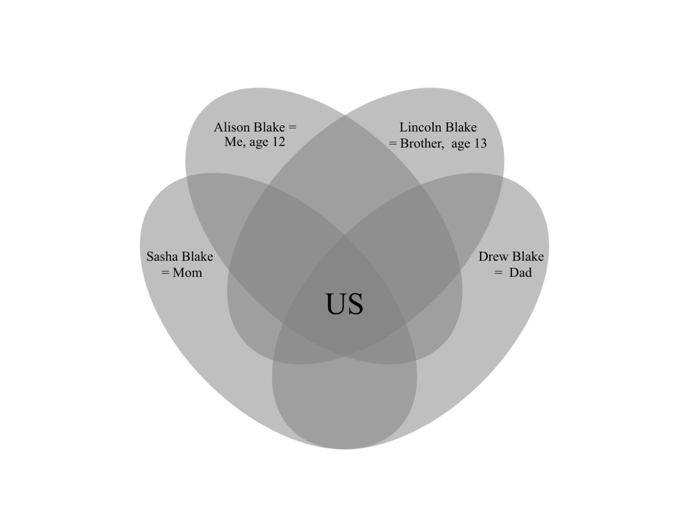
[Rachel Farguson, RF]
—
Rachel’s given a great overview of the class, so I’ll just use this note to pick up a couple of strands of the conversation I found particularly interesting, and to highlight a couple of areas we didn’t quite get onto.
One strand had to do with what I called my opening ‘bullshit’ question – When is/was the Now of ‘American Fiction Now’? In other words, what are the problems of periodisation we encounter in contemporary lit studies? How do we limit or demarcate a literary period that is by its nature still emergent? So we explored this idea that defining ‘now’ is an inevitably historicist enterprise that entails rethinking and refiguring earlier stages in literary history, and particularly what we’ve called, as a kind of shorthand, postmodernism. This is something that was discussed in the secondary reading – it was interesting to me that we talked more about the Kelly essay than the Hungerford – but that we can also see Franzen working through, in a different way, in ‘More of Same’ and ‘Why Bother’? As Rachel has said, and as we discussed at some length in class, Franzen is preoccupied with what he sees as the declining social capital of the novel at the close of the twentieth century, and with the continued viability of writing socially engaged fiction, either along the lines of the 19th century realist novel, or in the vein of the big postmodern ‘systems’ novels he admired as a student and younger writer. For Franzen, the causes of this decline are, among other things, TV/ saturation of information technology and commercial culture (see also David Foster Wallace’s essay), and the role of identity politics in fragmenting the literary field and marketplace. Both of these causes were, for Franzen, incubated in the academy, and we discussed the at times antagonistic, at times symbiotic relationship between literary production and universities – a history Mark McGurl sketches here, and which Gunter Leypoldt summarises here.
I don’t think we explicitly made this connection in class, but this question of historicising the contemporary seems bound up with the question of the place of history in the contemporary novel – something I’m sure we’ll also discuss next week. I quoted Jameson’s famous line of postmodernism being the age that forgot how to think historically – an epoch defined by a ‘weakening of historicity’, as he also puts it – and we might think more on how ‘post-postmodernism’ (if we’re going to call it that) might mean a ‘return’ to trying to think historically. We got on to the Egan a little later than I wanted (time’s a goon, right?), but Brandon’s discussion of temporality in the novel and the role of nostalgia seemed, in an appropriately recursive way, to circle back to these originary questions. It also put me in mind of this other great Dames essay on ‘throwback fiction’, his longer history of nostalgia, and this wacky book on the subject.
I also really enjoyed Brandon’s explanation of the A and B side structure in Goon Squad, which I’d somehow forgotten about when re-reading the novel for class, and his idea of the novel as a kind of concept album. It got me thinking about other contemporary novels that have a musical structure/ parallel, and about this broader tendency for ‘Theory Generation’ novelists in particular to see pop music as a kind of aesthetic cousin to the novel: I’m thinking of Jonathan Lethem’s The Fortress of Solitude, which he suggested was structured to resemble a CD box set chronicling the rise and break up of a soul group, or his novel actually about an alt- rock band, You Don’t Love Me Yet.
(this is a slightly non-linear note…)
Something I found interesting during our discussion of The Corrections was that we didn’t really talk about what seem to be the ‘big issues’ of the novel: late capitalism, globalisation, big pharma, surveillance etc… and since the class I’ve been asking myself why we didn’t talk about them. I don’t think they’re too difficult for us, so how come we avoided them? Too obvious? Too much like ‘theory’? Or are we just interested in other things? Caroline’s presentation certainly made a good argument for being more interested in character – if this is so, what does this say about Franzen’s attempt to combine the ‘deep’ characterisation of an ‘old-fashioned’ realist novel with some of the theoretical heft and cultural reach of a systems novel (what Rachel Greenwald Smith calls a ‘compromise aesthetics’)?
Two other things we didn’t get to: the reception history of The Corrections and in particular the Oprah entente. I purposefully left this off the reading list, because I didn’t want it to dominate our discussion of the novel, as it sometimes does in a class, and I figured you’d come across it. Anyway, if its new to you, I’d be interested in your thoughts. Second: how does our reading of The Corrections change when read alongside Freedom and Purity (we could ask something similar of Egan too)? [MK]


 AMERICAN FICTION NOW - 2019